
Haile Gebrselassie — The Long Run from Legend to Legacy
Season 4, Epsiode 3

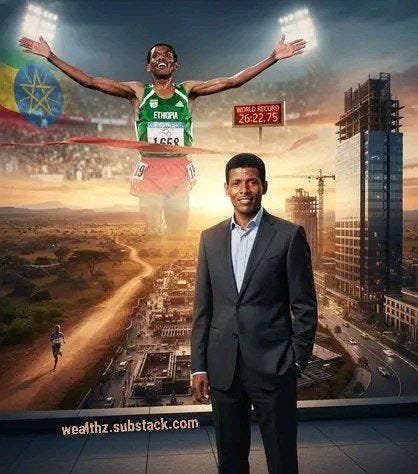
The Boy Who Ran to School
In the highlands of Ethiopia, before sunrise cuts through the fog over Arsi, a young boy runs. There are no running shoes, no stopwatch, no applause — just a determined heartbeat and ten kilometers between home and school. He isn’t training; he is simply living. Haile Gebrselassie was born on April 18, 1973, in Asella, Arsi Province, one of ten children in a modest family. Asthma made breathing difficult, but his determination made stopping impossible.
“I had to run to school and back every day,” he would later say. “Sometimes I ran simply because there was no other way.”
In the quiet rhythm of his daily journey, a world-class athlete was unknowingly being shaped. The thin boy in the Ethiopian mountains was already training for the world stage; the world just didn’t know it yet.
Talent Meets Tenacity – Discovery of a Champion
Haile first competed locally, sprinting across uneven dirt fields, often barefoot. Coaches noticed not only his speed, but his relentless push — a rare fusion of talent and will. By age 19, he joined the Ethiopian national team. Just a year later, at the 1992 World Junior Championships in Seoul, he claimed gold in both the 5,000 and 10,000 meters.
He wasn’t merely running to win. He was running toward a possibility — a future he had not yet defined but believed he could build.
“Every race was a chance to change my life,” he reflected.
Rise to Global Dominance
At the 1993 World Championships in Stuttgart, a 20-year-old Haile stunned the world by winning gold in the 10,000 meters. Four consecutive world championship titles followed: 1993, 1995, 1997, 1999. On the track, he was fluid, almost playful, earning the nickname “The Emperor.”
But his victories were not just about speed. They were about precision. About timing. About the art of endurance.
In the 1996 Olympics in Atlanta, he took gold in the 10,000 meters. Then came Sydney 2000 — perhaps his most dramatic race. With Kenyan rival Paul Tergat closing in on him, Haile kicked forward in the final meters, crossing the line first once again. The world watched breathless. He smiled. It was instinctive.
Over his career, he set 27 world records, competing across a range of distances—from 3,000 meters to the marathon.
He mastered the track. What no one expected was that he would master the markets too.
Transition – Running the Business Marathon
While still competing, Haile began investing his earnings. Not extravagantly, but intentionally.
“A career is short. A legacy must be built,” he would say.
He spent evenings reading business books, asking economists and business leaders for advice. He studied not as a scholar but as an athlete — through repetition, observation, and personal discipline.
He understood that the world of business, like long-distance running, was about pacing. About resilience. About preparing for challenges before they came.
He wasn’t preparing for retirement.
He was preparing for his next race.
Empire Built at High Altitude – The Business Portfolio
His business interests would expand into multiple industries — each like a segment in his ultimate marathon. Driven by vision.
1. Hospitality – Haile Hotels & Resorts
In 2010, he opened his first resort on the shores of Lake Hawassa. Today, Haile Resorts operate across multiple Ethiopian regions, lifting the hospitality standard and attracting both local and international tourism.
2. Industrial Leadership – Marathon Motors (Hyundai Joint Venture)
Through Marathon Motors, Haile introduced Hyundai vehicle imports and later began locally assembling electric cars. While many doubted Ethiopia could assemble modern vehicles, he saw it as another uphill mile he was ready to run.
3. Agriculture – Organic Coffee Farming
On over 1,500 hectares of land, Haile cultivates premium organic coffee. Rooted deep in Ethiopian tradition, his farm integrates sustainability and export-grade standards — proof that heritage can scale.
4. Real Estate Development
Commercial and residential property developments followed, especially in Addis Ababa. His investments built spaces for business, hospitality, and urban growth.
5. Culture & Wellness – Alem Cinema and Alem Fitness
One of Ethiopia’s first private cinemas and a modern fitness center bearing his wife’s name — workouts next to film screens, dreams next to discipline.
6. Education – Ayelech Degefu Memorial School
Named in honor of his mother, he established schools to cultivate not just athletes or entrepreneurs, but future thinkers.
Across these ventures, he has created thousands of jobs.
He didn’t just build businesses.
He built infrastructure.
He didn’t simply invest in profit.
He invested in possibility.
Running for More Than Medals – Social Impact
In 2001, he co-founded the Great Ethiopian Run — now Africa’s largest road race, attracting tens of thousands yearly. It is more than a sporting event; it is a celebration of national unity, empowerment, and collective fitness.
His influence extends beyond economy and sport. He contributes to awareness on health, business education, and youth empowerment.
He once said: “If I can run fast, I must also help others move forward.”
Risks, Challenges & Strategy
Operating in a developing economy, amid infrastructural and regulatory challenges, Haile’s business expansions were not without risk. The logistics of hospitality, auto manufacturing, and agriculture require resilience beyond capital.
Politically and economically, terrains shift — just as they do in cross-country races at high altitude.
His leadership style echoes his racing:
Start steady.
Breathe consistently.
Know when to accelerate.
“Investing in people makes a marathon sustainable,” he often emphasizes. Resources build businesses. People build legacies.
Legacy & Philosophy – Lessons in Endurance and Enterprise
For Haile, the athlete and the entrepreneur are not separate versions. They are the same person, running different kinds of races.
The track taught him:
Discipline — waking up at 5AM, with or without fatigue.
Patience — waiting for the right moment to overtake.
Visualization — seeing the finish line before stepping on the track.
Pacing — conserving energy for where it matters most.
Endurance — knowing the race isn’t over until it’s over.
He applied these same principles to business.
He once observed:
“Winning is not at the finish line. Winning is decided in how you prepare for the moment when the finish line comes.”
The Man Still Running
Today’s Haile still wakes before dawn. He still runs — not to win medals, but to clear his mind before meetings. One morning he may jog past a hotel under construction; another, he may run next to the Hyundai assembly plant. His pace is slower, but his stride remains purposeful.
He ran to school to learn.
He ran to the world to win.
Today, Haile Gebrselassie runs businesses —
so that others can walk a better future.
Join us: ➡️ Instagram | Telegram | X ⬅️