
Crunching Success — How Fritos and Lay’s Built a Snack Giant
Season 4, Epsiode 5

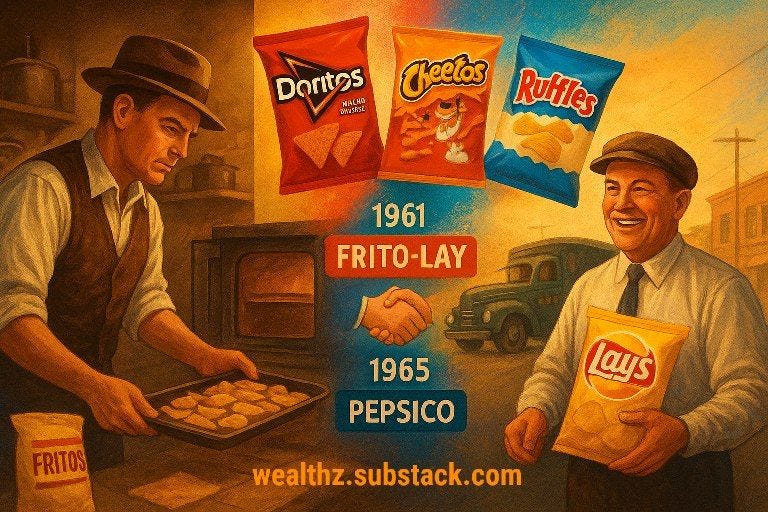
In the heat of a Texas summer in 1932, a young entrepreneur named Charles Elmer Doolin walked into a small café and tasted something curious—a crunchy corn chip with potential. The business behind it was small and struggling. Doolin bought the rights, the equipment, and even the recipe, and began making chips with his family out of their kitchen. Using his mother’s oven and the back of his Ford Model T as his distribution system, he sold bags of Fritos door-to-door. The company started not with machinery or capital—but with ingenuity, persistence, and a clear belief that the humble corn chip could become America’s next big snack.
Across the country, at nearly the same time in Nashville, Tennessee, another entrepreneur was hustling with bags of potato chips. Herman W. Lay had entered the snack business with little more than a borrowed $100 and a delivery truck. He expanded aggressively, going door to door, then store to store, eventually acquiring a local chip manufacturer. Lay was creating something different—potato chips for everyday satisfaction, sold widely and consistently. Where Doolin was innovating flavor and formulation, Lay was mastering distribution and scalability.
For decades, the two men built parallel snack empires without even knowing their destinies were aligned. Doolin shaped the corn chip category with Fritos. Lay turned potato chips into a household staple with Lay’s. They were visionaries with different strengths—one was a culinary innovator, the other a distribution powerhouse.
Then came 1961.
The Merger That Changed Snacking
When The Frito Company and H.W. Lay & Company finally merged to form Frito-Lay, Inc., it wasn’t simply a business decision—it was the fusion of innovation and reach. Doolin’s creations finally gained access to Lay’s distribution infrastructure. Lay, in return, acquired products with unique identities and unmatched flavor potential.
The combined company immediately became a national force. America didn’t just get more chips. It got two strong product lineages united under one system. A corn-chip pioneer brilliant in flavor engineering joined forces with a potato-chip businessman brilliant in scaling and business discipline.
Four years later, lightning struck twice.
Becoming a Global Giant
In 1965, Frito-Lay merged with Pepsi-Cola, forming PepsiCo. This move transformed snack chips into an international business aligned with one of the most powerful beverage networks in the world. Now Frito-Lay snacks could travel alongside Pepsi products—from gas stations in Chicago to corner markets in Cairo.
At this point, Frito-Lay was no longer an American success story. It was global.
Their portfolio expanded through product launch and acquisition:
✨ Doritos (tortilla chips) became symbols of bold flavor and cultural energy.
🔥 Cheetos taught the world that messiness could be a marketing strategy.
🥨 Ruffles, Tostitos, SunChips, Fritos, and Lay’s became category-defining billion-dollar brands.
Behind each was a combination of two principles inherited from the founders:
🧪 Experiment bravely (Doolin’s legacy).
🚚 Scale relentlessly (Lay’s legacy).
It worked. Today, Frito-Lay is not just a division—it’s the driving economic engine of PepsiCo’s food business. In the U.S. alone, it controls more than half of the salty snack market. In many countries, the word “chips” became synonymous with “Lay’s,” “Doritos,” or “Cheetos.”
Join us: ➡️ Instagram | Telegram | X ⬅️